Mental Health
Thank the Passenger
Some anxious thoughts are trying to help. They just should not be allowed to drive.
Some anxious thoughts are trying to help. They just should not be allowed to drive.
I do not like standing on sewer grates.
You know the round metal lids in the street? Or the rectangular ones on the sidewalk with the little slits in them? The ones everybody else walks over like they are just part of the ground?
I see those things and my brain turns into a building inspector.
What if that one is loose?
What if it has been getting weaker every time someone walks across it?
What if this is the step where it finally gives out?
Then my brain gets creative, and not in a good way. It starts asking how deep the hole is. It wonders what is down there. It reminds me that falling through a hole in the sidewalk would be a stupid way to die, which is true, but not especially helpful while I am trying to walk to lunch.
Most of the time, I walk around it.
Not because I have done the math. Not because I have researched sewer-lid failure rates. I avoid it because it is easier than listening to the voice in my head yell at me.
That voice is annoying.
It is also trying to protect me.
That is the part I hate admitting, because I would rather treat it like an enemy. I would rather tell the anxious part of my brain to shut up, go away, and let the adults handle this. But if I am honest, the voice is not completely wrong. There is a signal in there.
The signal is, “Hey, pay attention.”
The translation is, “You are about to fall into a sidewalk hole and die.”
Those are not the same sentence.
Here is the picture that helps me.
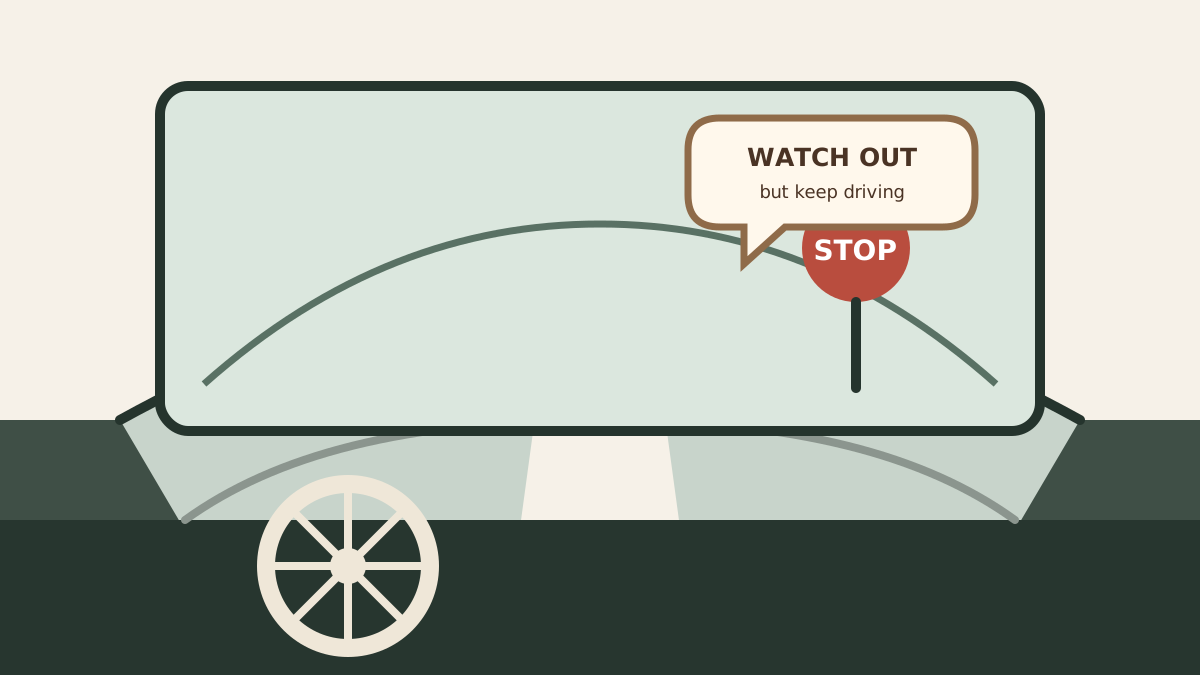
Imagine you are driving a car, and there is a nervous passenger in the seat next to you. Not a mildly nervous passenger. A white-knuckled, brake-stomping, imaginary-pedal-hitting passenger.
You come up to a stop sign.
The passenger screams, “Stop! Stop! Stop! You’re going to crash!”
Technically, there is useful information buried in there. There is a stop sign. You should stop. The passenger noticed something real.
The problem is the volume.
The passenger did not say, “There is a stop sign ahead.” The passenger acted like death had entered the intersection wearing a reflective vest.
That is what happens in my head. A useful signal gets translated into a catastrophe.
I remember something I said five years ago, and my brain says, “Hey, maybe that did not land the way you meant it.”
That could be useful. Maybe I need to apologize. Maybe I need to learn something. Maybe I need to be more careful next time.
But the passenger does not stop there.
The passenger says, “Actually, everyone probably hates you. Also, you are the kind of person who ruins every relationship you touch. Also, we should spend the next forty-seven minutes replaying the conversation with alternate dialogue.”
Very productive. Great use of company resources.
Psychologists have a name for part of this: catastrophizing. It is when the brain takes a possibility and treats the worst version of it like a foregone conclusion.
There is another phrase I like even more: perseverative cognition. That is the fancy name for repetitive worry and rumination. In a 2006 paper called “The perseverative cognition hypothesis”, Jos Brosschot, William Gerin, and Julian Thayer described how worry and rumination can keep the stress response active before or after the actual stressful event. The event can be over, or it can be imaginary, and your body may still act like it is sitting in the middle of it.
Your brain can keep serving you the same scary thought because it believes it is helping. It thinks repetition equals preparation. It thinks if it shows you the mistake enough times, you will never make it again.
Sometimes that is a gift.
Sometimes it is just a passenger screaming at a stop sign.
When the passenger starts yelling, I usually want to do one of three things.
The first is to obey him.
If the passenger says the sewer grate is dangerous, I walk around it. If he says the conversation from Tuesday was a disaster, I replay it. If he says the email I sent sounded stupid, I read it again, and again, and again, until the words stop looking like words.
This feels like control, but it usually is not. It is just handing the steering wheel to the most frightened person in the car.
The second option is to fight him.
“Shut up. You’re being ridiculous. Nothing is wrong. Stop thinking about it.”
I have tried this. Maybe you have too. It works about as well as telling a panicking person to calm down. Now they are panicking, and they feel stupid for panicking, and somehow everybody is louder.
The third option is to pretend I cannot hear him.
La la la la la.
This one feels spiritual if I use the right words. I can call it faith. I can call it confidence. I can call it taking every thought captive, which is a real thing, but sometimes I am not taking the thought captive. I am just shoving it in the trunk and hoping it does not find the tire iron.
None of these options are great.
Obeying the passenger gives him too much power. Fighting him keeps my attention on him. Ignoring him usually makes him louder.
So I am trying to learn a fourth option.
Thank him.
Then keep driving.
That sounds absurdly simple, which is how I know it is probably annoying.
When I get to the sewer grate, I can say, “Thank you for trying to keep me safe.”
Then I can look at the grate. Is it obviously broken? Is it tilted? Is there any actual reason to think this specific piece of metal is about to betray me?
If not, I can walk over it.
I do not have to sprint across it like I am proving something. I do not have to tap dance on it while making eye contact with God. I can just walk.
The point is not to humiliate the fear.
The point is to put it back in the passenger seat.
This works with more than thoughts. Sometimes the signal is a raw feeling: anger, sadness, dread, jealousy, shame. Those feelings can also climb into the front seat and start grabbing at the wheel.
Anger may be saying, “Something here matters.”
Sadness may be saying, “You lost something.”
Anxiety may be saying, “Please pay attention.”
Those are signals. They deserve to be heard.
But they are not always good drivers.
So maybe the move is not, “I should not feel this.” Maybe the move is, “I hear you. Thank you for trying to help. Now sit down.”
Then I keep my eyes on the road.
I still get to choose the next step.
Maybe I apologize. Maybe I make a plan. Maybe I ask for help. Maybe I walk across the sewer grate. Maybe I decide, for practical reasons, to go around it this time.
The difference is that I am choosing.
Not the passenger.
And yes, this is easier to write than to do. Most useful things are. Practice does not make the passenger disappear, at least it has not for me. But practice does seem to help me hear the difference between the signal and the screaming.
There is a stop sign ahead.
That does not mean we are all going to die.